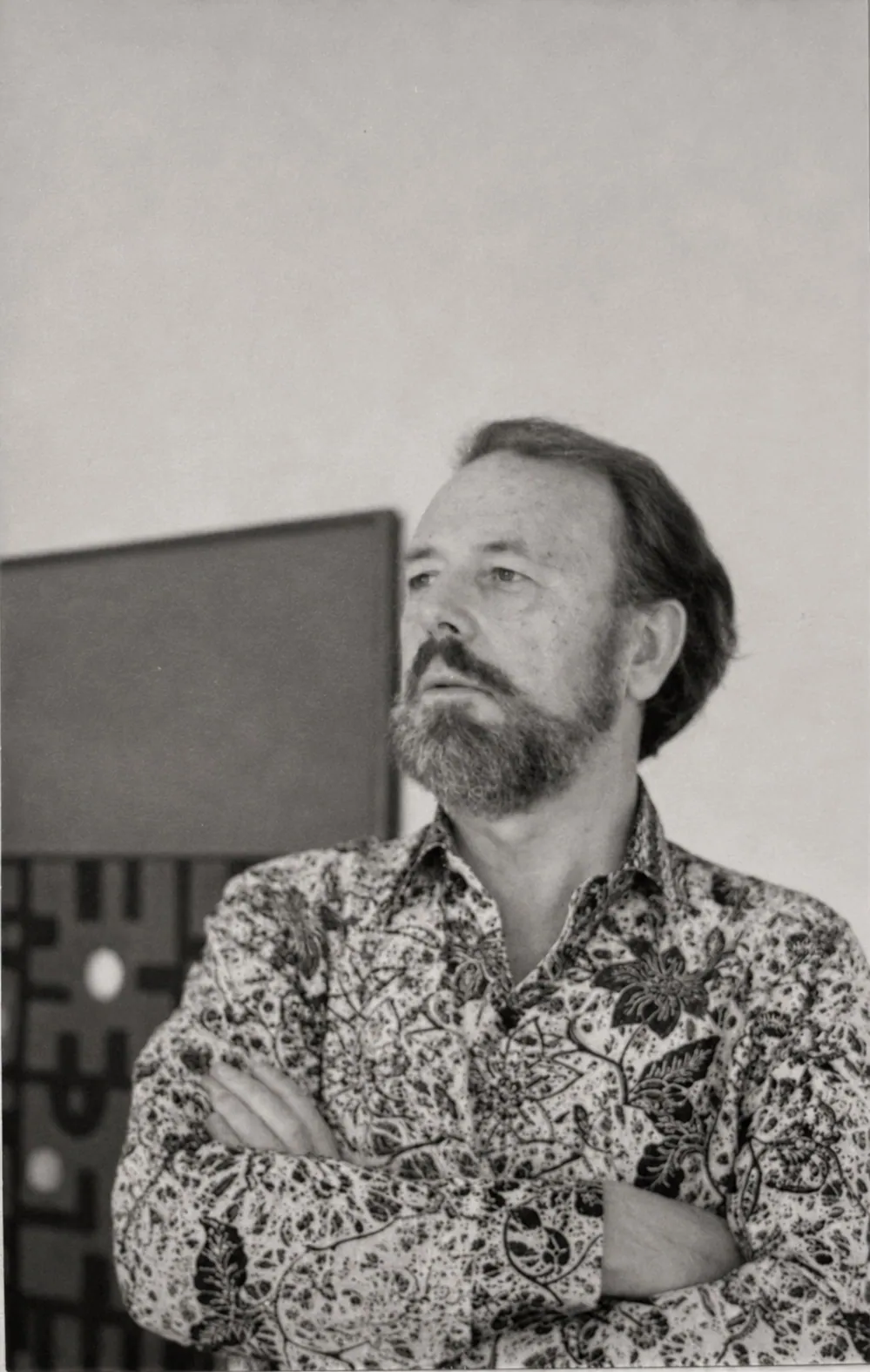
A search between geometry, figuration and the presence of matter.
1989
Between France and Uruguay, Miguel Kohler-Jan developed a body of work nourished by his travels and his discovery of pre-Columbian cultures.
His figurative beginnings gave way to research into the sign and the letter, to which his work with sand would give a new presence.
1929
Paris, the early years
Born in Paris on 24 April as Michel André Kohler, he was of Alsatian descent through his father and Uruguayan through his mother. He lost his mother at the age of four and grew up with his aunts. His childhood notebooks bear witness to an early taste for drawing and invented stories.
1955
From Paris to Montevideo
After his schooling at the Lycée Louis-le-Grand, he took a law degree at the Sorbonne. He then left for Uruguay and studied fine arts and printmaking at the National School of Fine Arts in Montevideo. His travels and his part in archaeological work in South America fed his discovery of pre-Columbian cultures.
1962–1968
Artistic life in Uruguay
He served as commissioner general for Uruguay’s National Fine Arts Commission. His first solo exhibition was held at the Andreoletti gallery in Montevideo in 1964; another followed at the Instituto Amigos del Arte in 1967.
1968–1969
An international career
He represented Uruguay at the international exhibition of contemporary art in Monaco in 1968, then took part in the Festival de la peinture in Cagnes-sur-Mer and the Salon d’Automne in Paris in 1969. The City of Paris acquired his print Los Ojos. His correspondence about the gift of Colloque Bleu to the Château-Musée de Cagnes-sur-Mer sheds light on his abstract research.
1970–1975
The letter and the sign
The Psicosis series and the typographic compositions make the letter a building block of the image. His graphic work was shown at the Ljubljana biennials in 1973 and 1975. In spring 1975 the Galerie Pernety in Paris exhibited twenty-two paintings, accompanied by a critical text by Georges Dussaule.
1980–1990
Figures and matter
The series Le Faiseur d’oiseaux, Manifestación and Revelación extend his graphic research. Sand, worked on wood, canvas and paper, gives the figures a surface whose relief holds the light.
1984
An award in Brno
He received the Czech Peace Council Award in Czechoslovakia.
1997
Stockholm
He was awarded a prize of excellence at the miniature art exhibition in Stockholm.
2003
The Tai-he prize in Beijing
He received the “Tai-he Masterpiece” prize at the Beijing International Print Biennial. He continued to take part in events devoted to printmaking, small formats and bookplates until 2010.
2011
Nice
Miguel Kohler-Jan died in Nice on 26 October. The works and documents that survive now make it possible to continue the study of his path.
Childhood portrait1980sOn the terrace of his villa in Nice, 1990s
The project
Brought together in a private collection, a substantial part of Miguel Kohler-Jan’s work is now preserved alongside the documents that illuminate its history. This ensemble forms an artistic heritage whose richness is discovered through the works themselves, but also through the traces of a life shared between France and Uruguay.
Arina Ivanenko, art historian and head of the collection, wishes to give this legacy a place in today’s cultural life. The work of research and conservation thus prepares the ground for its presentation, so that the works can be discovered, studied and appreciated by a wider public.
This website opens a first door onto this universe. As research continues and opportunities arise to show the collection, it invites visitors to discover a body of work that is still largely unknown, in the conviction that its preservation takes on its full meaning when it is shared.